Every year, Google Marketing Live rolls out a new wave of features and the room applauds. Most years it’s incremental. Better targeting here. A new bidding option there. Marketers nod, take notes, go back to what they were doing. But Google Ads AI 2026 is a different story.
This year was different.
I watched the full GML 2026 keynote and came away with one clear conviction: the foundational assumptions most marketers have been running on are now obsolete. Not heading toward obsolete. Already there.
Here’s what I mean.
The Search Box Just Got Rebuilt From Scratch
Google made the biggest update to the search interface in 25 years. The box now expands. It accepts long, conversational input. It connects to your Gmail, your Photos, your Calendar. It’s becoming a personal agent that already knows your context before you finish typing.
AI Overviews now has 2.5 billion monthly users. AI Mode crossed 1 billion and is doubling every quarter.
People aren’t typing “HVAC repair near me” anymore. They’re typing “my furnace is making a rattling noise when it first kicks on in the morning and I have a two-story house with a basement unit, what’s probably wrong and who should I call.” That’s one search. It used to be ten.
If your ad strategy is still built on a list of short-tail keywords, you are not showing up in those searches. You’re not even in the room.
Keywords Are Officially a Legacy Concept
This is the part that should get every advertiser’s attention.
Google said it plainly: you can’t manually choose keywords anymore. The queries people are using in AI Mode are too long, too contextual, too nuanced for a human-built keyword list to capture. AI Max for Search and Performance Max are now the only real paths to showing up in these new search formats.
AI Max is out of beta. It’s driving 27% more conversions than manual campaigns. Lufthansa saw a 24% ROAS increase. IKEA saw 65% more non-branded clicks.
The resistance to handing control to Google’s AI is understandable. Advertisers have spent years building finely tuned campaigns. But the query stream has changed underneath them. Manual targeting is no longer fighting for control. It’s fighting for irrelevance.
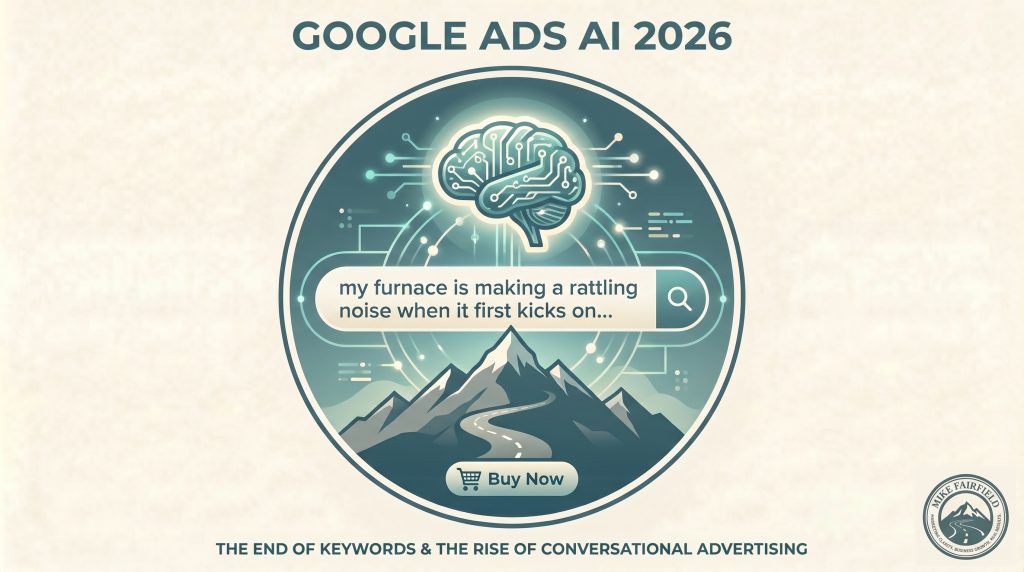
Google Ads AI 2026: Ads Are Now Answers
The new ad formats coming to AI Mode are a genuine rethink of what an ad even is.
Instead of a headline and two description lines interrupting a search result, you’re now looking at ads that answer questions. Conversational ads that explain why a product solves your specific problem. Direct offers surfaced at the exact moment someone is ready to buy. Lead forms that pre-fill and qualify prospects inside the ad itself.
This matters for a simple reason: if the AI is giving people answers, the ad has to be an answer too. A banner sitting next to an AI response doesn’t get clicked. An answer that fits the conversation does.
AI Brief is the new control layer for this. Advertisers set their brand voice, audience guardrails, and creative direction in plain language. The AI works within those parameters. It’s not perfect, but it’s the right architecture.
Commerce Is Going Frictionless
Google announced the Universal Commerce Protocol — a shared standard co-built with Amazon, Meta, Microsoft, Salesforce, and Stripe. Those five don’t agree on much. The fact that they all signed on to this tells you something.
Universal Cart lets shoppers add items while browsing Search, watching YouTube, reading Gmail, or chatting with Gemini. One cart. Cross-merchant. Checkout with GPay in a few taps.
YouTube just got a native Buy Now button inside shoppable video ads.
The path from discovery to purchase is compressing. What used to take multiple sessions and multiple platforms is collapsing into a single conversation. Businesses that are set up for this will capture buyers at the moment of decision. Businesses that aren’t will keep losing them at the friction point.
What This Actually Means
None of this is coming. It’s here. AI Mode is already over a billion users. AI Max is globally available. Universal Cart is rolling out this summer.
The gap in Google Ads AI 2026 isn’t between big budgets and small budgets. It’s between businesses that are set up for AI-era advertising and businesses that are still running 2019 playbooks with better software.
The marketers who figure this out early are going to look very smart in about eighteen months. The ones who wait until it’s obvious are going to be explaining to their clients why the numbers don’t look like they used to.
Google Ads AI 2026 is the clearest example of Jevons Paradox in marketing right now. Google actually name-dropped this in the keynote says that when technology makes something more efficient, we don’t do less of it. We do exponentially more. AI is making search more efficient. People are searching more than ever. The opportunity is expanding.
The only question is whether you’re positioned to capture it.